30 Nov 2009

Week 2 – Reconsidering the Project Pt2:


As I developed the new concept further, I decided upon the design of the child the soldier would encounter at the end; a five/six year old girl:


Injured child concept. The teddy bear in her arm in this scene is the teddy that is dropped on the ground. My thought was as the soldier carried the girl past it, they or another soldier would pick the teddy up and hand it back to her.

My main reason for using such a young character was to capture the idea of innocence and naivety. With an adult character, the audience may have not have necessarily had sympathy for their plight, as it was the citizens who supported the extremists’ rise to power in the first place. A child of that age, however, would be oblivious to such concepts, and would have had no say in who was in power, thus an audience would immediately sympathise with her. This will help drive home the message of the piece.

* * *

While discussing the project with a colleague, Andrew, I find myself reconsidering the player perspective of the piece, having the child the player character as opposed to the soldier. Having the child as the focus would not only be more interesting, but allow the project greater scope for emotions in the design, as the child, not understanding everything that is happening, will likely ‘imagine’ much more of the environment than an adult, who would see the world for what it is. So for example, a tank rumbling by to an adult would be just a tank, but a child might see it as a large fanged mouth, thrashing like a monster. Changing to the child also allows the reinforcement of the sympathy for her (by viewing all of the events from her perspective), and the friendly image of the soldiers, whom she would initially only hear and think evil, until encountering them at the end and realising are not so, especially when one cradles her and carries her outside; seeing this from the child’s perspective, I feel, will be an interesting sequence, and one I haven’t seen in many (if any) games in the past.

The change of character, of course, necessitated a redesign of the level, with the player starting in a ruined basement, and discovering the items originally dotted around the street as they make their way through the room (with the exception of the teddy, which the player will see being dropped in a cut scene, but wont be given back till the end).


Concept for new main hub area; the ruined building that the girl has run into. It is strewn with rubble and wreckage, a particularly large pile forcing the player to navigate around the circumference of the room in order to reach the door.

The triggered events would be from her perspective, and will provide some interesting points of view for the audience; in the speech clip, for example, the viewpoint will begin with the girl unable to see anything with the adults crowded around here, then she will be picked up by someone and moved to where she will be able to see. The fact the girl is injured will also allow me to return to the mirror’s edge-esque camera considerations I was looking at with the original Raijin concept (see first post); a limp can be created by having the camera jerk in one direction and then lazily move back up as she walked, and tears can be simulated using whimpers and light blurring effects on the screen.

Unlike the previous idea, here the soldiers interact with the child from the outset; it is their yelling and the rumble of vehicles that wakes her up, and inspires the player to move (whether to investigate the noises or to run from them). She may see only vague silhouettes or parts of them for the first half of the game, to help the player feel the tension the girl would feel, thinking they are looking to kill or hurt her. One of them eventually hears or sees her and starts calling out, and the tone and words of his voice begins to reveal their true nature, inspiring the player to crawl through a gap in the rubble, where she finally meets the soldiers face-to-face, who then carry her to a truck, which drives away down a street, ending the game with a gentle fade out.

The designs of the soldiers themselves I will look to next week. I am looking to maintain a multi-cultural atmosphere to this project, so I will likely design the soldiers to appear to herald from a variety of races, to prevent any particular culture being portrayed as the good guys. The extremists too will lack any particular cultural focus, merely be a amalgamation of stereotypes studied in research into such groups.

Week 2 – Reconsidering the Project Pt1:

Based on the comments received during my first presentation, it was evident that the project needed serious redevelopment, and was likely not even achievable for a single person to complete alone. I therefore focused my attentions for the weeks remainder (Wednesday till Saturday) on looking back on the project and deciding ways I could take it in a new direction, whilst at the same time making the project more feasible for one person to complete. At the same time I am continuing to enquire with other groups as to whether they require new members, though it appears that few if any, have such a need.

I have made the decision to follow my tutor’s advice and abandon the “Raijin” storyline that I originally planned to use. With hindsight, I realise that I have been trying to force the game concept to fit around my original storyline idea, instead of the other way round. This was a mistake, and was dragging my project away from its original concept of focusing on the political message, as Dave was explaining. Therefore, I have focused most of this week on developing an alternative concept for the game, specifically one that focuses less on a deep story, abandons the anime art style, and focuses more on the actual anti-extremism message I wish to portray with the game.

* * *

The alternative idea I decided to explore is that of a town ravaged in a recent conflict. The political extremists, in this case would have left the area prior to the game’s beginning, leaving only remnants of their presence within the ruins, and the town was now being liberated by another, non-extreme military force, whom the player was a soldier in. Whereas the Raijin concept was a highly interactive stealth game, I am considering for this concept a more observational mechanic, revolving more around the player witnessing events than on deeply interacting with the world. Items scattered around the ruined city ‘hub’ environment would trigger small segments of game play, laid out as if they were the player character’s memories or imagination deciphering earlier events (the rise of the nationalists, their taking of the town, the horrors by them) making this more of a 3D explorative environment than a fully-fledged game, which I feel would better suit the objective of broadcasting the socio-political message.


When developing this concept, I also considered using background music, feeling that music is a vital component in establishing atmosphere in an environment. Searching for a sombre piece, I was reminded of the popular song, Agnus Dei by Samuel Barber, which was notably used in the Computer game “Homeworld”. I feel the music achieves the feeling I want well, and so may make use of it in this project as my BGM.

Artistically I will keep to the concept of simple models, but instead of a stark, stylised approach as found in anime, I would look to a more realistic texture treatment, using features such as bump mapping to enhance the look of objects. My main inspirations for the environment and atmosphere in this case are war movies such as Band of Brothers or Enemy at the Gates, notably those scenes set within city environments.


Concept sketch of the layout for the level, focused around a devastated street intersection and two parked military vehicles. As with the earlier Raijin project, I wished to try and contain the level as best as possible; focusing on a smaller, carefully designed and filled space as opposed to a large open level, hence the street setting, with the routes out blocked by rubble, vehicles, or soldiers warning of dangers in that direction. This will be highly beneficial for me if i decide to carry on working on the project alone.

The overall level would use muted, low-key colours, with one colour in particular dominating (a mustard yellow is the current one I have in mind). This is to contrast with several items that would be placed around the environment (as shown in the picture). The street would therefore become a hub-world, with each of these items triggering a small piece of game play or cut scene in another environment. Each event follows a different aspect of the extremist activity about the town, with the item serving as trigger chosen to symbolise that particular aspect.

Start: The player begins inside a friendly APC, the interior of which is pitch black. The rear ramp then slowly lowers and allows them exit. I felt this would be a powerful image to begin the game with; the music triggering in the pitch black, then the ramp opening to show the devastated world outside the vehicle.

Money Bag: found on the second floor of a building, clasped by a dead arm reaching out of a pile of rubble; a person who had been desperate to keep the money. It represents the desire for wealth or power, or fear of loosing them; issues that are commonly a base motivation behind supporting a politically extreme group, who usually draw their support from poorer parts of the population. Approaching the bag would trigger a scene where the player is in an estate, observing the impoverished citizens of the pre-ruined town.

Poster: Found on a wall, this is a propaganda poster left behind from when the extremist party ruled over the town. It will trigger a scene where the player is amongst citizens at an extremist rally, listening to a speech by a man on a pedestal. Over time, more and more of the group begins to cheer and punch the sky, with the player perhaps being given the option to do the same.

Derelict Tank: The burnt hulk of an enemy tank. It triggers a scene of the extremists building up arms, and/or of a battlefield in which they are invading another nation, showing the horror of their lust for conquest.

Teddy Bear: A Child’s teddy bear discarded on the floor. It will trigger a scene of the town being attacked, but set within the same space, with civilians fleeing for cover, abandoned by the extreme government they thought would protect them. In the scene she drops the bear in a crush of people, and flees into a large building in the corner of the environment.

Injured Child: This would be the child the player had watched drop the bear in the previous sequence, having survived the fighting by hiding in a basement of the building. It is set in the actual city environment instead of shifting to a different period of time. She is badly injured, so the player carries her out of the building, which serves as the last sequence of the game. I feel this a good symbol of a new hope for the town now it had been liberated, with this new faction (the soldier’s) here to now help the town rebuild.

With the soldier helping the child, I also like presenting a scenario in which a soldier is providing aid and showing sympathy; I sometimes feel that games centred on soldiery focus too heavily on mindless combat and savagery, showing no other aspects of a soldier’s life, which during deployments commonly involves humanitarian work. By having the player soldier not fight at any point in the level, the warrior image is lessened and his human side is brought more to the fore, reinforcing the idea of the liberating soldiers being not invaders, but a ray of hope for the town.

4 Nov 2009

Week 2 – First presentation & Comments:

Week 2 saw us present our concepts to both our tutor and rest of the group; a good opportunity to see one-another progress, exchange ideas and give recommendations on one another’s work. I was also hoping to use this presentation to interest classmates who were not yet in a final group, and hopefully gain their assistance on the project.

As my turn came to give a presentation, i found there were mixed reactions to the concept. There was interest in the edutainment idea, agreement that Unreal could achieve the lighting and first person camera results the project aimed for, and on the avoidance of realism in the game.

However, many did not feel the Anime style and Japanese cultural references (namely the Neko character) suited the project, fearing that it was an overused style, and the links to the genre it would bring through its use would ‘drown out’ the morals and deeper meaning the game is trying to get across to the player, preventing the game from achieving its objective. Some also voiced confusion as to the game’s mechanics and whether the character described, an untrained, weapon less civilian, would react to the situation with the slow, stealthy, Splinter Cell-esque manoeuvres the game used. Our tutor also felt the project focused too heavily on storyline, and suggested I consider a game design without any story consideration, so as to maximise the impact of the message I am trying to convey. (In hindsight, I also imagine my presentation was not helped by the extremely large amount of information I attempted to cram into the short presentation time. In future I need to be more selective with my presentation material, avoiding deep descriptions and focusing on only the bare essentials.

Another major hurdle I noticed was the fact that most of the group had already decided upon their groups and their projects decided upon. The specifications of this project assumed I would be coordinating a group, and with it now likely I will be alone, I am no longer confident that the project will be achievable. I have come to the conclusion that I must decide quickly either to continue the project, or abandon the idea completely and see if another of the groups require more members.

24 Oct 2009

Week 2 – Socio-Political commentary concepts:

With the basic specification and art direction devised in week 1, I had the chance to focus on the storyline aspects of the game at the end of the 1st week and the start of the 2nd.

A centre point of this project is the idea of ‘edutainment’; taking knowledge of a real-life issue, and then shaping it into a media that people will find entertaining. As they are entertained, they take in the knowledge within the piece and so are educated without truly realising it. Though this procedure is best known for its use in young children’s programs, it can be found throughout almost all media to varying degrees, as many dramas have a moral or idea at the core of their plots, usually involving one of more of the characters discovering the concept and being affected by it. A well known example of this process at work is the famous Animal Farm by George Orwell in which, through a story of animals seizing control of their farm from humanity, Orwell makes a critique of the Soviet Revolution and the USSR’s rise to power, presenting the masterminds of the union as the pigs who come to rule over the farm. Other examples include the anime works of Mamoru Oshii, who’s Jin-Roh (literally “Man-Wolf”, though commonly called The Wolf Brigade in English) depicts an alternate universe Japan puppet-governed by a war-winning Nazi Germany, but is actually a platform for Oshii-san’s protests against the real US’s post-war occupation of Japan (throughout his younger years, Oshii-san was deeply involved in student protest groups of the time), and many similarities can be found between aspects of Jin-Roh’s plot and those of real-life Japan at that point in history. Perhaps his most famous work, the first Ghost In the Shell movie, demonstrates a less political use of the process; exploring through its characters the meaning of being human, presenting a science fiction world of cybernetic humans (including a main character with a brain and upper spine her only biological parts), man-like robots and artificial intelligence to serve as a comparison to humans (as present-day Earth contains no life form that can mirror humanity like Oshii’s machines can).


*   *   *

 I intend this project to be an ‘edutainment’ piece about political extremism and its dangers, namely focused on fascist or nationalist governments such as seen in Nazi Germany. This is a topic I have great personal feelings about, and exploration or consideration of it and other aspects of politics and human interaction form the core of many of my current game ideas (and a core aspect of any future career plans). For me, edutainment represents a fundamental possibility with games to truly benefit people and improve cross-cultural relations, as opposed to simply fill time with entertainment.
The human nation, in which the story is set, Pygar, was designed to be representative of post-WWI Germany, sharing the history of bullying by foreign powers, recession and poverty, followed by a rise of nationalism and rapid industrialisation (which creates the vast industrial metropolis in which the game is set). Also incorporated are the Neko race previously mentioned, who are mistreated and discriminated against under the Pygar regime, serving to represent those groups (Jews, Gypsies, etc) who were likewise mistreated under Nazi Germany. The project will not make any direct links to the Nazis themselves; the storyline concepts create the fictional game world to entertain the audience, the audience’s mind will make the link between it and real life fascism/nationalism themselves.


23 Oct 2009

Week 1 – Anime Art Style Decision:

For this project I wanted to avoid a realistic art style, as this is very common in the modern market (especially with games made for the Unreal Engine). Considering my options, I noticed that the hyper-real lighting I had decided upon was commonly used in Anime, and so decided to veer the project in this direction. I have great interest in anime myself, giving me a degree of experience with the genre, and the story for which the project is made was designed with an anime-style presentation in mind.


Extract from the anime movie “Ghost in the Shell 2: Innocence”, which demonstrates well the art treatment i wished for this project. Note the dominance of light sources in the environment (especially the fire from the guns in the scene).

I feel an anime style will be an advantage for the project. It provides a high degree of ‘finish’ (the feeling that a product is complete and well polished, with all the assets meshing well) even with very simple assets. A lot of modern games companies feel that to create a ‘finished’ product, they must fill the screen with realistic game play, high-poly models, fully mapped textures and deep play mechanics, all of which take time to complete, and (especially in the case of making a game realistic) result in many games feeling and looking much the same in terms of aesthetics.

Anime is a much more mutable art direction, allowing the director to shape the style how he sees fit without loosing the Anime feel (unlike Realism, where strict limits must be maintained). ‘Ghost in the Shell’ from above for example, like most anime, involves what are (compared to realism-based games) relatively simple character designs and textures, yet it (like many of the more darker, more mature-audience intended animes) achieves the same aesthetic quality as a realism game (such as Call of Duty 4).


A comparison of a shot from the Ghost in the Shell series “Stand Alone Complex 2nd Gig” (top) with a screenshot from the game “Call of duty 4” (Bottom). Both are effective and popular media, and both enjoy the same quality of finish and overall the same atmosphere. However, the assets within GiTS are much simpler than the true-to-real-life assets in CoD4, and so was likely somewhat easier both financially and time-wise to produce.


An extract from the Anime series "Lucky Star", an example of an even simpler, more 'traditional' anime style. Highly styalised, many aspects of the characters are unrealistic (such as square, pupilless eyes and blue and pink hair) and the majority of textures feature solid colour with only block highlights or shading applied. However, as the asthetic has been well maintained throughout the media, it maintains the same 'finished' feel as CoD 4 or GiTS despite its much simpler assets.

15 Oct 2009

Week 1 – First Project Concepts & Lighting Direction:

As part of our preparations for this year, we were asked to produce a short presentation of our game concept, to be presented before our tutors and rest of the 3rd year students. I saw this presentation as a prime opportunity to attract those colleagues among the year still looking for project work inaddition to the presentation of our idea to the tutors.
My project is an accumulation of several decisions made over the course of the year; first of which was the decision to definitely work with the Unreal engine. Originally made by Epic Games for the Unreal Tournament game series, it is a highly adaptable (with sufficient knowledge) and powerful engine, and has been used as the base for many current high-end graphics games, such as Gears of War, Tom Clancy’s Endwar, and more recently Mirror’s Edge. A major advantage for its use is also its availability; the university has Unreal installed on many of the PCs, and owning the latest Unreal Tournament myself, with which the program ships, I have access to the engine outside of university hours.


Taking into account the limitations of time and capability, I quickly decided upon a First Person perspective for the project, as this is the perspective Unreal predominantly caters for and would thus require no modification to the game engine before asset insertion could begin.
 The game will be based on a storyline I had originally conceived in my spare time, which I felt suited the chosen engine and perspective, and would be interesting to develop. The plot centres on a fictional nationalist country known as Pygar, and a group of characters (a human named Simone Felke, and a member of a race of human-shaped, cat-like creatures (strongly inspired by Japanese Neko culture) named Sheena, whom discover a conspiracy within the government to convert the country’s weather control technology into a weapon. With time constraints in mind, I decided I would produce only a small part of the whole piece, presenting my final production as a ‘demo level’ that would be shown to a publisher to demonstrate the aims of a longer-term game project.


I wanted to try and avoid a shoot-em-up scene, which is quite common in Unreal titles, and considered alternative uses of the first person perspective. I eventually settled on a nightmare scene in which the cat girl character, with no weapon, is being chased through an office by a police team, and the player must navigate through the environment while avoiding the enemies to reach a pre-determined location. I was interested in how the first person perspective could be modified through camera movements and effects to simulate the character’s body movement; vision could be blurred in places to represent the eyes focusing, a water effect added to represent tears, and models of the character’s hands and feet shown in the player’s view during moves to add to the immersion of the player into the game world. The game Mirror’s Edge applies this use of special camera effects in game play, and is a good example of the direction I am hoping to take Raijin. The fact it was made in the Unreal Engine serves as proof that the engine is capable of supporting my desired game assets.


A Trailer for the game “Mirror’s edge” which showcases the game’s camera system and use of hand and feet models. Despite the strong similarity in camera style and game play mechanics, note that Mirror’s Edge is designed around representing the speed and quick thinking needed to conduct parkour (free running; a sport which plays prominently in the player’s movement). My project will be a much slower-paced game, with more emphasis on thinking and analysing the situation than on speeding through obstacles.


*   *   *

I also decided I wanted this project to explore the use of “hyper-real” lighting effects; combining bright neon-style lights with deep, black shadows to produce a much deeper colour palette and contrast than would normally be found in more realism-simulating environments. This is an interest of mine that I gained during my 2nd year of the course, but have not had a chance to explore with any depth in my university work.


Some of the Reference pictures collected during previous projects, showing applications of this “hyper-real” lighting style. The style is specifically prominent in Japanese Anime Cartoons, commonly through the use of a dark colour palette for the environment and one particularly dominant light source (such as Sun or Moonlight).

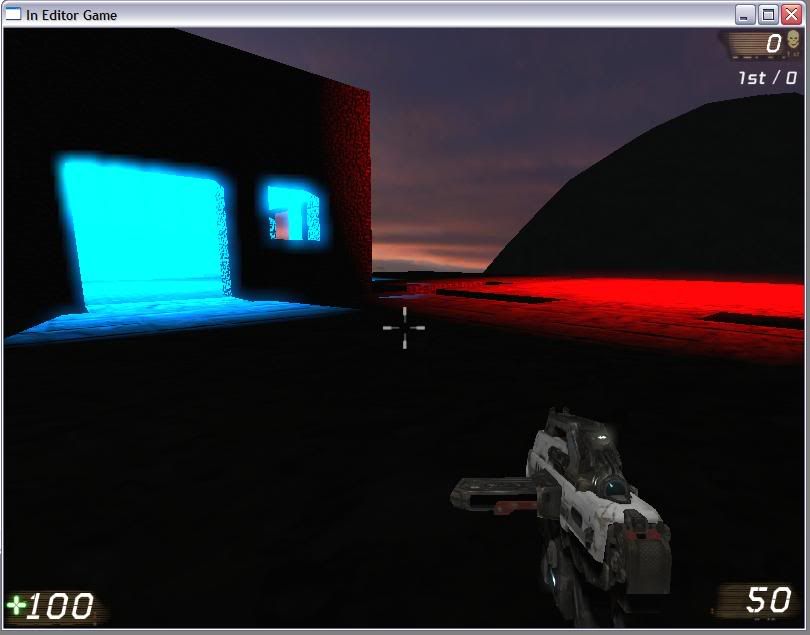
This style is particularly well suited to Unreal, which contains its own powerful lighting engine, and similar applications of lighting can already be found in several Unreal engine projects. I feel it creates a strong sense of depth and atmosphere in a image, even in media using very simple art styles (such as cartoons), and can be used to convey particular emotions in a scene, through choosing colour use and the ratio of lights or darks in shot, if desired by the designer, to a far greater extent than media that looks to recreate a realistic image.


The above images are from a simple experiment during an Unreal Engine tutorial run by a visiting games research company. The simple structures in the level have been lit using only a handful of lights with little modification, and already the atmospheric contrast of light and dark can be seen. Note how the bright light ‘drowns’ out the textures to an extent; this is a prominent aspect of the style, and I will it will create a unique visual aesthetic that will stand out from most unreal titles at this time, which focus on realism-based graphics.


8 Oct 2009

Week 0 - The Beginning

This blog will follow the progress of my 3rd Year Games Design Project from September 2009 to June 2010. I am hoping to use this oppitunity to focus on developing my own project idea, as opposed to year 2 where i decied to play an assisting role in my group. I finished the main 2nd year project with a slightly dissapointing grade, and feel that partly to blame was a lack of work that was mine in the final product that was shown (most of the assets that were designed or made by me ended up unused in the demo we made). This was not the fault of anyone in the group, but merely bad luck. With this project however, I want to make sure I have content being shown in the project, hence my decision to lead.


I have a definite idea of a project i wish to undertake (known for now as "Project Raijin"), which will focus on my interests in light-dark contrasts and socio-politcal aspects of games. I am not confident that i would be able to create the whole project alone, and so feel that gathering a team together to complete the project will be vital, and feel a project of this kind, with a strong premade concept, will attract colleagues on the course who have skills and interests specific to certain areas of game design (such as coreography or modelling), but struggle in the actual idea development stage. Raijin will give them and myself the oppitunity to focus on their specific interests with the concept i have devised as a base, though with this arrangment comes the need to ensure the project is a group work, and any ideas or opinions teamates have a taken into account; i do not wish to simply force my ideas upon them.


In terms of acuall choices of teamates, there are several other people on the course whom i am hoping to get in contact with upon my return. I have gained an offer of assistance from one colleague currently in the 2nd Year of the CGD course, Andrew Fletcher, whoose advice and skills will be of great benefit to me on the project. However, i do not wish to place too much work on his shoulders, as he will have other projects he will be undertaking as part of the 2nd Year curriculum and will likely only be avalible for short periods.