My project is an accumulation of several decisions made over the course of the year; first of which was the decision to definitely work with the Unreal engine. Originally made by Epic Games for the Unreal Tournament game series, it is a highly adaptable (with sufficient knowledge) and powerful engine, and has been used as the base for many current high-end graphics games, such as Gears of War, Tom Clancy’s Endwar, and more recently Mirror’s Edge. A major advantage for its use is also its availability; the university has Unreal installed on many of the PCs, and owning the latest Unreal Tournament myself, with which the program ships, I have access to the engine outside of university hours.
Taking into account the limitations of time and capability, I quickly decided upon a First Person perspective for the project, as this is the perspective Unreal predominantly caters for and would thus require no modification to the game engine before asset insertion could begin.
The game will be based on a storyline I had originally conceived in my spare time, which I felt suited the chosen engine and perspective, and would be interesting to develop. The plot centres on a fictional nationalist country known as Pygar, and a group of characters (a human named Simone Felke, and a member of a race of human-shaped, cat-like creatures (strongly inspired by Japanese Neko culture) named Sheena, whom discover a conspiracy within the government to convert the country’s weather control technology into a weapon. With time constraints in mind, I decided I would produce only a small part of the whole piece, presenting my final production as a ‘demo level’ that would be shown to a publisher to demonstrate the aims of a longer-term game project.
I wanted to try and avoid a shoot-em-up scene, which is quite common in Unreal titles, and considered alternative uses of the first person perspective. I eventually settled on a nightmare scene in which the cat girl character, with no weapon, is being chased through an office by a police team, and the player must navigate through the environment while avoiding the enemies to reach a pre-determined location. I was interested in how the first person perspective could be modified through camera movements and effects to simulate the character’s body movement; vision could be blurred in places to represent the eyes focusing, a water effect added to represent tears, and models of the character’s hands and feet shown in the player’s view during moves to add to the immersion of the player into the game world. The game Mirror’s Edge applies this use of special camera effects in game play, and is a good example of the direction I am hoping to take Raijin. The fact it was made in the Unreal Engine serves as proof that the engine is capable of supporting my desired game assets.
A Trailer for the game “Mirror’s edge” which showcases the game’s camera system and use of hand and feet models. Despite the strong similarity in camera style and game play mechanics, note that Mirror’s Edge is designed around representing the speed and quick thinking needed to conduct parkour (free running; a sport which plays prominently in the player’s movement). My project will be a much slower-paced game, with more emphasis on thinking and analysing the situation than on speeding through obstacles.
* * *
I also decided I wanted this project to explore the use of “hyper-real” lighting effects; combining bright neon-style lights with deep, black shadows to produce a much deeper colour palette and contrast than would normally be found in more realism-simulating environments. This is an interest of mine that I gained during my 2nd year of the course, but have not had a chance to explore with any depth in my university work.


Some of the Reference pictures collected during previous projects, showing applications of this “hyper-real” lighting style. The style is specifically prominent in Japanese Anime Cartoons, commonly through the use of a dark colour palette for the environment and one particularly dominant light source (such as Sun or Moonlight).
This style is particularly well suited to Unreal, which contains its own powerful lighting engine, and similar applications of lighting can already be found in several Unreal engine projects. I feel it creates a strong sense of depth and atmosphere in a image, even in media using very simple art styles (such as cartoons), and can be used to convey particular emotions in a scene, through choosing colour use and the ratio of lights or darks in shot, if desired by the designer, to a far greater extent than media that looks to recreate a realistic image.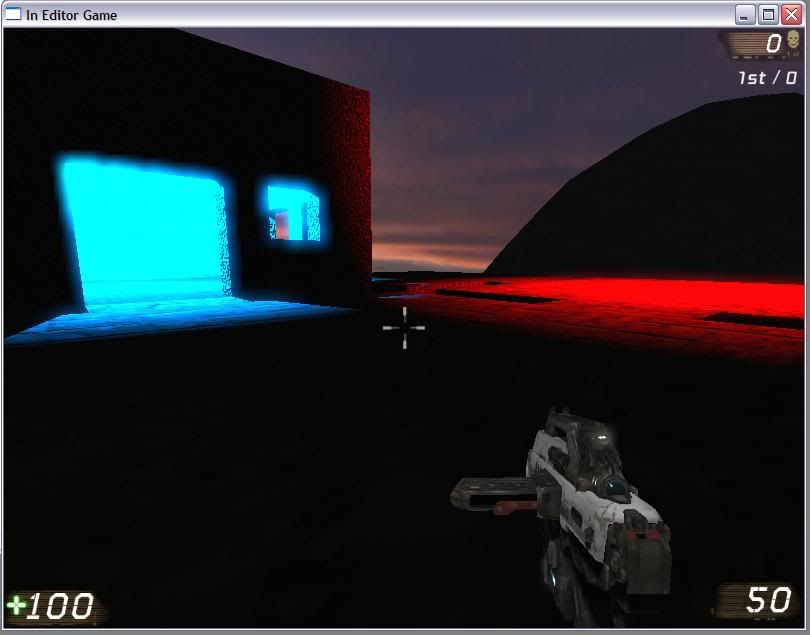
The above images are from a simple experiment during an Unreal Engine tutorial run by a visiting games research company. The simple structures in the level have been lit using only a handful of lights with little modification, and already the atmospheric contrast of light and dark can be seen. Note how the bright light ‘drowns’ out the textures to an extent; this is a prominent aspect of the style, and I will it will create a unique visual aesthetic that will stand out from most unreal titles at this time, which focus on realism-based graphics.


No comments:
Post a Comment