The first order of business therefore was to complete a prototype map of the actual level itself, to give a vague idea of the asset layout and to allow me to walk though the order in which events would transpire. At first I aimed to complete this on paper, but found myself struggling to bring the ideas together. I made the decision therefore to instead try using Unreal itself to create the prototype, making use of in-built unreal assets as stand-ins for my own uncreated assets. This proved a lot more successful.
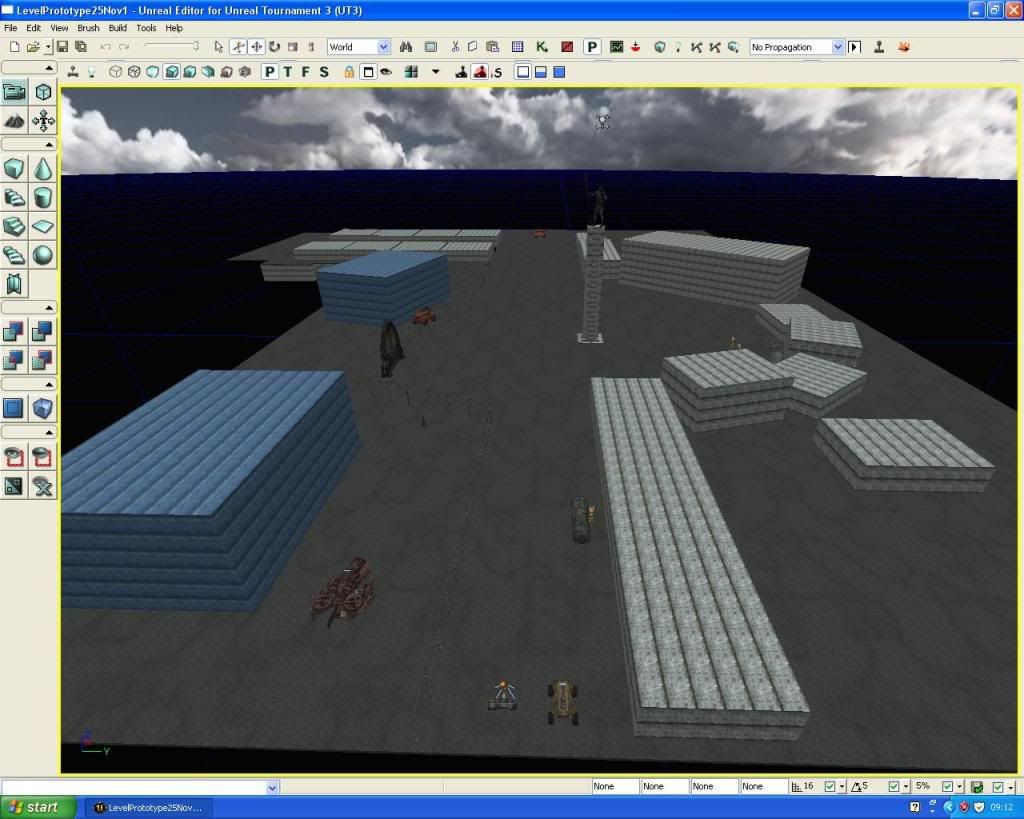
An overveiw of the level ptototype made in Unreal. At the advice of tutors i have kept the content as simple as possible; only cuboids or static meshes (pre-made models avalible in Unreal) to represent items.
The user begins in a side-street (the bottom of the screen on the picture) leading into the market area, which is the central point of the level. To the left of this is a fenced off area that will represent an upper-class estate, full of luxury and serene colours and sounds that contrast with the normal design of the market, and is designed to represent a feeling of unfairness some people may feel; why should all this luxury and happiness be restricted to a few? To the north of the market is a long street that will represent a run-down, lower class estate contrasting with the luxury estate seen earlier. The houses here will be attached rather than separate, and designed to give a feeling of claustrophobia and neglect.
The planned base series of events will be as follows. The level begins in the first instance; the “normal” world. The player moves into the market, buying an apple from a stall in the side-street on his way. In the market their eyes are drawn to a group of people to their right; one of the shops has been broken into. As he investigates, hearing the sobs and the anger of the crowd, he notices a figure looking from the corner of the northern estate. Approaching him causes the figure to run around the corner, and the player gives chase.
Walking along the poor street, listening to the noises of desolation and sadness, the player funds stairs into an underground room, in which a large congregation of people are facing an extremist character on a pedestal. This character will proceed to give a speech encouraging support for their party. Eventually the crowd begin cheering wildly and running out of the room. The player, upon following, finds the world has begun changing. The level is now in the second instance; the takeover.
A crowd of red people are running up the street, growing in size as they move. Wherever they go, the terrain behind them changes from blue to red. They stop at the end of the street, and as the player walks over, the ground begins to rumble. The giant propaganda tank rumbles into the market square, followed by the cheering crowd. It turns to the large locked gate into the rich estate and rams it open, allowing the crowd to rush in, completing the takeover of the city.
At first the takeover is positive, and the player will be thinking “is this really bad?” but then they will begin to see problems. Shops being closed down, propaganda covering the walls. People being dragged away because they are “different”. They will notice the stall from which they bought the apple will now be wrecked; the owner has been arrested.
Things continue to gown further and further downhill. The sky turns darker, lighting turns a deeper red. The background is replaced with a meek setting, large factories springing up in the distance, sprouting vast lines of tanks rumbling off into the distance. Events lead up to the player being branded “different” and so they must flee from the town. Being captured or successfully fleeing will mark the end of the piece.
* * *
As well as the usual meets with Dave, I had the opportunity to book meetings with two additional members of our staff; Corrado Morgana and Matt, to get their opinions of the project so far.
Showing my idea (and in a later meeting, my prototype) to Corrado, he was very interested in the idea of a piece designed to provide narrative on real life, especially related to political aspects. Discussing the mechanics, he coined the term “Tourist-like game play” to describe the observational focus, which I think sums up the project quite well. He suggested several games that I should play to help get inspiration for the tone and themes of my piece (such as “Dear Esther” and “Darfur is dying”). The former is a mod for Half Life 2 which revolves around exploring an island environment, and so would help develop the observational aspects, whereas the latter was, like mine, an edutainment game aiming to present a political message; in its case speaking out against the current Darfur conflict.
He recommended I use “nonsense” dialogue (speech that doesn’t use coherent sentences) for any dialogue in the game, to enhance the multi-cultural concept of the piece; the nonsense would mean the viewer focuses on the visuals of the game, and any audience regardless of nationality would get the same level of experience from the game. In situations where understanding what the character is saying would be important, I can make use of imagery to ‘fill the gaps’. In the speech, for example, a series of propaganda posters can be displayed behind the speaker, their imagery depicting what he would be saying.
He also introduced an interesting idea for the end of the piece; a train the player gets aboard to escape the town. The Term “underground railroad” is normally used to describe a network of sympathisers who help smuggle endangered people out of discriminatory nations (such as one that helped smuggle black slaves out of America, or Allied airman out of France if they crash landed), so representing the concept with an actual train would fit the symbolic nature of the project well.
* * *
Matt is a specialist in sound for games, so I focused our meeting on how sound might be applied in the piece as I guided him through the level’s prototype. For me, sound & music is one of the most important elements in creating an atmosphere for a piece, so I was glad I was able to get input from someone whose expertises focus on the field. I mentioned Corrado’s idea of using nonsense dialogue and he agreed with the concept.
A suggestion of his own he put forward was to use the political speech in the entire piece as opposed to just the speech scene itself, getting louder or softer depending on the distance the player was from the location the speech is happening. At first we considered it beginning at the start, but I suggested first triggering it when the player sees the broken into shop, so the rising volume would represent the tensions of the townspeople and rising support for the extremists.
Matt put forward the idea of using radios as a theme for the piece’s sounds and music, with elements of static and white noise shaped to create different sounds. Though this piece is designed to not have any specific time period, radio is quite common in revolution stereotypes, and played a major role in WWII both on and off the front line, as there were no TVs.


No comments:
Post a Comment